
line of RVs sitting in a parking lot in snow

How to winterize your RV

Updated June 8, 2026 . AmFam Team

As you wrap up your summer adventures, you’ll want to consider all that goes into winterizing your recreational vehicle. Winterizing your camper or RV not only saves it from damage — it makes it easier to get started next season! If you decide to do this work yourself, you’ll avoid paying an RV garage, and you’ll have a pretty good idea of what it takes to de-winterize your RV in the spring.

Whether you’ve got a big rig, trailer, fifth wheel or anywhere in between, take a look at these tips to get your ride ready for its winter hibernation.

What does it mean to winterize an RV?

Freezing temperatures can take their toll on more than just your rig’s water lines. Winterizing is primarily about keeping your water lines from freezing by flushing them and then adding antifreeze in certain places. As you’ll see, there’s really more to it than that.

Coverage that travels with you
Stay protected on every adventure with RV insurance from American Family. Our customizable coverage helps you prepare for the road ahead.

How much does it cost to winterize an RV?

On average, it costs $130 to $170 for a basic winterizing package at an RV dealer, depending on the size and class of your RV. If you pay a similar amount to de-winterize in the spring, those costs can add up over the years, which is why many RV owners choose to do it themselves.

RV winterization tips: what you’ll need

Before you begin, check your owner’s manual. Some RVs are equipped with built-in winterizing valves or controls, so your model’s requirements may vary.

Commonly needed supplies, which you can get online or from your RV dealer, include:

  • Nontoxic RV/marine antifreeze (propylene glycol)—often two to three gallons
  • Tubing for the black water holding tank and a cleaning wand
  • A water pump converter kit or hosing that connects to the pump inlet or an external hand pump
  • A water heater bypass kit
  • Hand tools to install and remove drain plugs
  • Ant and roach traps
  • Anti-rodent foam and peppermint granules or packets
  • Moisture-absorbing dry packs

Step 1: Flush your RV’s plumbing system

Follow these steps to remove water from the system:

  • Remove any water line filters.
  • Drain and flush all freshwater tanks, systems, and lines.
  • Drain, flush, and clean the gray and black holding tanks at an RV-approved dump station.
  • Turn off the water pump.
  • Let water cool, then drain the water heater tank by opening the pressure relief valve.
  • Turn all sink, shower, and outside faucets to the open position.
  • Flush the toilet.
  • Open the hot and cold low-point water drains by removing the plugs.
  • Turn on the water pump briefly to help push remaining water out—then turn it off right away to avoid pump damage.
RV camped next to a lake

Step 2: Add antifreeze to water lines

If your manufacturer recommends it, add antifreeze designed specifically for RVs and campers. Never use automotive antifreeze. Many newer RVs include a water heater bypass kit, which helps prevent wasting gallons of antifreeze to fill the water heater tank. If you don’t have one, ask your RV dealer about installing it.

To get antifreeze into the water lines:

  • Close all open faucets and water valves.
  • Bypass the water heater.
  • Install the water pump converter kit, or connect to the pump inlet, so the system can pull in the antifreeze.
  • Turn on the water pump to circulate the antifreeze.
  • Starting with the fixture closest to the water pump, slowly open each faucet/valve until antifreeze begins to flow, then close it.
  • Repeat for each fixture, working from closest to farthest from the water pump, both inside and out.
  • Replace the antifreeze container feeding the converter kit with a full one as needed.
  • Don’t forget washing machines, ice makers, and other appliances if your RV has them.
  • Flush the toilet until antifreeze flows.
  • Pour about a cup of antifreeze down each drain to protect P-traps.
  • Pour the rest of your antifreeze into the freshwater tank.
  • Turn off your water heater’s heating element.
  • Double-check that all faucets are closed.

Step 3: Keep pests from moving in

Rodents and insects can squeeze into surprisingly small openings in your RV, and storage season gives them time to get comfortable. A little prevention now can save you a lot of cleanup later.

To help keep pests out of your RV:

  • Remove all food, including pantry items.
  • Seal cracks and crevices inside and out with anti-rodent foam.
  • Place peppermint granules or packets in storage areas and nearby entry points.
  • Set ant and roach traps around the interior.
A couple cuddling in the back of their parked RV.

Step 4: Prepare the engine, batteries, and electrical system

If you’re storing a motorhome, take time to protect the drivetrain and power systems:

  • Top off engine oil, brake fluid, transmission fluid, and winter-rated windshield fluid as needed.
  • Add fuel stabilizer, fill the tank, and run the engine for about five minutes.
  • Check battery fluid levels, if applicable, per the manufacturer’s instructions.
  • Fully charge all batteries.
  • In freezing climates, disconnect and store batteries safely in a warm, dry location, or disconnect at the terminals—negative side first—for warmer climates.
  • Turn off the main breaker and disconnect from shore power.
  • Remove batteries from small devices, like clocks, remotes, sensors, and detectors.
  • Remove electronics, such as TVs, tablets, and laptops.
  • Follow the manufacturer’s storage instructions for onboard generators.
Steel wool may help keep critters out
Some RV owners stuff steel wool or aluminum foil into openings to discourage pests. If you do, tie a note to the steering wheel so you remember to remove it before your first spring trip.

Prepping your RV’s tires for winter

Taking care of your RV tires during the winter months is just as important as attending to them out on the road. Follow your owner’s manual for off-season tire care. Here’s our advice on managing your tires:

  • Park the RV on concrete if possible
  • Set the parking brake
  • Set wheel chocks
  • Engage the leveling jacks (not stabilizing jacks) to prevent the tires from developing flat spots
  • Use external jacks to lift the RV
  • You can also just move the RV half a tire rotation two or three times over its winter break
  • Lower the stabilizing jacks enough to keep the RV steady while you’re inside it, but it shouldn’t be taking on any load
  • Spray the RV with UV protecting conditioner
  • Cover the tires for the winter

Managing propane sources and fittings

Propane can expand and contract when the temperature changes and that can lead to leaks and problems next year. Here are a few things to do to help keep your propane tanks working well:

  • Refill all propane tanks
  • In freezing climates, remove external propane tanks and safely store in a protected and warm place — but not in the RV
  • Protect propane fittings with plastic bags and rubber bands
  • Replace any hoses or fittings that are showing signs of cracking or wear

Take on spring cleaning before winterizing

Much like vacation homes, you should unplug, clean the refrigerator and leave the door open during storage to prevent mold and mildew. Remove any food items, toiletries and medicines. Spend a little time wiping down and cleaning up your RV before you put it to bed for the winter:
  • Vacuum all floors and carpets
  • Spray down and wipe all surfaces
  • Remove all bedding, clothes and linens for laundering
  • Place cans of dry-packs silica around the RV
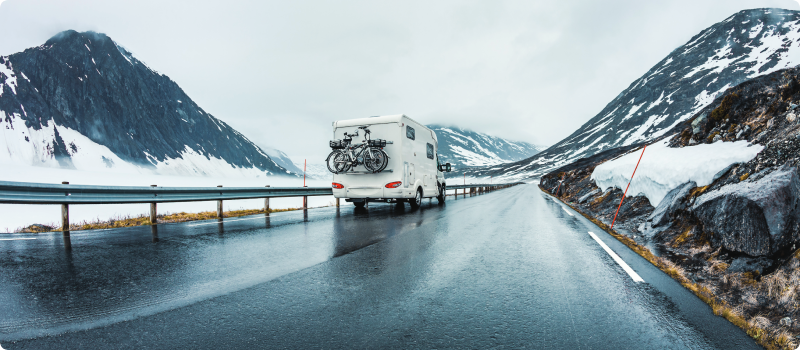
RV traveling through mountain area during winter weather

Winterizing your RV’s exterior, roof and awning

Protecting your RV from harsh winter weather can add years to its life. These tips can help you keep your RV’s awning and everything else in great shape while it’s in storage:

  • House your RV under a shelter
  • Cover the RV with a breathable tarp
  • Place a waterproof tarp on the surface where the RV will rest
  • Extend the awning fully and wash it according the manufacturer’s directions, rolling it back up after it’s completely dry
  • Apply a slip-on awning cover (rigid, if possible) to protect it from the elements
  • Close every roof vent and plug other vents open to the air with steel wool or aluminum
  • Apply silicon caulk to the exterior where small cracks have developed
  • Cover the AC unit
  • Clean the sewer hose and store it

It may seem like a lot to do but with a little work, you can add years of enjoyment to your RV or camper. And before you know it — it’ll be time for another season of adventures!

As you’re giving your RV some TLC this fall, remember to check in with your American Family Insurance agent and review your RV coverage options. With a well-crafted policy and a solid winterization strategy, your RV can be protected from the elements and the unexpected — taking you onto the open road well into the future.

This article is for informational purposes only and based on information that is widely available. We do not make any guarantees or promise any results based on this information.

Tools & resources

Explore our tools and smart tips.